
 <p>A look at what's behind their claim of a 630,000-seller gap — and why builders, lenders, and investors need both views.</p><h2 id="tldr">TL;DR</h2><ul><li>Redfin published a striking finding last month: 630,000 more home sellers than buyers nationally — the largest gap in their records dating back to 2013..</li><li>Their model measures who's actively competing in the market right now — not who could enter next.</li><li>I spent an hour pulling REAPI data on the supply that's not on the MLS yet: vacant properties, pre-foreclosures, and absentee high-equity owners.</li><li>In Florida alone: 4.78 million absentee high-equity owners. If just 5% list, that's 239,000 new sellers from one state — nearly 40% the size of Redfin's entire national gap.</li><li>These two views aren't competing. They're complementary. Redfin shows you the stage. We show you backstage.</li><li>Buyers' Market vs Sellers Market is highly regional. </li><li>Anyone with capital exposed to Florida residential should be modeling this pipeline now — not after it shows up in next quarter's MLS data.</li></ul><hr /><p>A community I'm in (mostly options traders, mostly not real estate people) shared a Redfin chart last week showing 630,000 more home sellers than buyers nationally. It's a striking number. Largest gap on record, dating back to 2013.</p><p>The conversation in the chat went where you'd expect: "Is this priced in yet? Is this the start of something?"</p><p>I went and read Redfin's actual methodology. Then I ran some queries. Here's what I learned.</p><h2 id="redfins-model-is-good-economics">Redfin's model is good economics. </h2><p>Most "market reports" you read are vibes wrapped in confidence. Redfin's isn't.</p><p>They use a Cobb-Douglas matching function with constant returns to scale — standard methodology in labor economics, applied to housing. The framework comes from peer-reviewed work by Genesove & Han, Anenberg & Ringo, Piazzesi et al., and others.</p><p>The clever part is how they count buyers. They can't count buyers directly — there's no MLS for "people actively house-hunting." So they back the number out using Little's Law. If you know how long the median buyer takes from first tour to closing, and you know how many sales happened, you can infer how many buyers must have been in the market. Like estimating how many people are inside a coffee shop by watching how long each customer takes and how many leave per hour. </p><p>So when Redfin says there are 1.36 million buyers and 1.99 million sellers in the market, they're measuring something specific and measuring it well: who's actively competing in the matching process right now.</p><p>That's a real, important question. It's just not the only one.</p><h2 id="what-the-model-isnt-designed-to-capture">What the model isn't designed to capture</h2><p>Redfin's "sellers" count is — by their own definition — the number of active MLS listings. That's the right call for measuring market tightness. A vacant property isn't competing for buyers. A pre-foreclosure isn't on anyone's tour schedule. An absentee owner who hasn't listed isn't part of the matching dynamic.</p><p>But those properties exist. And under the right conditions, they enter the market.</p><p>This is where REAPI lives. We track 159 million+ U.S. properties whether they're listed or not. We can answer a different question: what's the supply pipeline behind the active market?</p><p>So I ran the numbers.</p><h2 id="florida-where-the-buyers-market-is-loudest">Florida, where the buyer's market is loudest</h2><p>Redfin's data shows Miami as the strongest buyer's market in America — 162.6% more sellers than buyers. The whole state of Florida is a buyer's market.</p><p>Here's what REAPI surfaces in Florida right now:</p><p>Active MLS listings: 409,209 Of those, sitting 60+ days: 277,419 (67.8% of the market) Of those, with a price cut since March 1: 127,390 (31.1% of the market)</p><p>For comparison, Massachusetts (a more balanced market): only 1.0% of active listings have cut price in the same window. Florida sellers are cutting price 31x more often than Massachusetts sellers. This is the cleanest real-time signal of buyer leverage you can pull.</p><p>So far, this confirms Redfin's directional finding. Buyer's markets are real, and you can see the leverage in the data.</p><p>Now the part Redfin doesn't measure.</p><h2 id="the-supply-pipeline-behind-the-active-market">The supply pipeline behind the active market</h2><p>In Florida, REAPI shows:</p><ul><li>193,067 vacant properties — homes nobody lives in, owners haven't listed</li><li>44,360 pre-foreclosures — supply that's coming whether buyers are ready or not</li><li>4,782,572 absentee high-equity owners — owners with significant equity who don't live in the property</li></ul><p></p>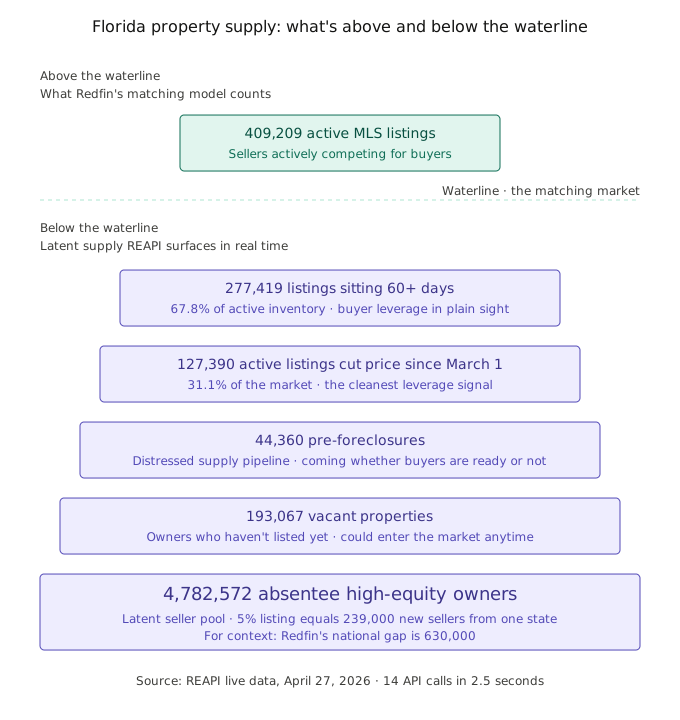
Discovery
Learnings
- auto_storiesStories
- categoryAreas
- helpFAQ
- forumConversations
- descriptionPapers
- mailNewsletters
- video_libraryVideos
- timelineTimeline
Guidance
- codeTechnology of APIs
- business_centerBusiness of APIs
- campaignEvangelism of APIs
- gavelGovernance of APIs
- historyHistory of APIs
- account_balancePolitics of APIs
Toolbox
- domainProviders
- apiAPIs
- cloudSolutions
- buildTools
- verifiedStandards
- gavelRegulations
- horizontal_ruleHeaders
- layersOverlays
- extensionExtensions
- schemaSchema
- policyPolicies
- ruleRules