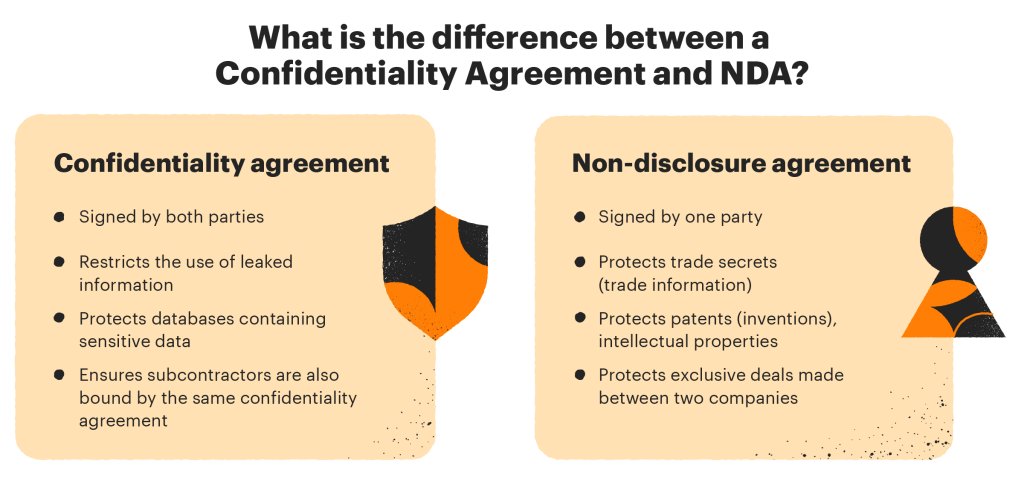
Confidentiality agreement vs NDA: What’s the real difference?
calendar_today
April 30, 2026
person
svitlanaomelia
domainpandadoc
Disclaimer: PandaDoc is not a law firm. This article is for informational purposes only and does not constitute legal advice. Consult a licensed attorney for guidance on your specific situation.
A confidentiality agreement and a non-disclosure agreement (NDA) both protect sensitive information from unauthorized disclosure, but they are not identical. The core difference is directionality: a confidentiality agreement is typically mutual, binding both parties to secrecy, while an NDA is usually unilateral, restricting only the receiving party.
In practice, a mutual NDA and a confidentiality agreement serve the same function.
The terms are used interchangeably in many business contexts, and courts generally interpret these documents based on their clauses, not their titles. Understanding the structural distinction helps you choose the right document, draft stronger protections, and avoid common mistakes that weaken enforceability.
This article covers the difference between the two, when to use each one, what every agreement should include, what happens if one is breached, and how to create either document using a template.
What is a confidentiality agreement?
A confidentiality agreement is a legally binding contract that obligates all signing parties to keep specified information secret and not use it for unauthorized purposes. Unlike a standard NDA, a confidentiality agreement is typically mutual — meaning both parties share sensitive information and both parties are bound to protect it.
Confidentiality agreements can exist as standalone documents or as clauses embedded within a larger contract, such as a services agreement or a partnership agreement. They are most common in situations where the information exchange flows in both directions.
Common scenarios where confidentiality agreements are used:
• Joint ventures and co-development projects where both parties contribute proprietary technology or processes
• OEM and supplier negotiations where both sides share manufacturing methods, pricing models, or client lists
• Business partnership discussions where both parties disclose commercially sensitive information before signing a formal contract
• Merger and acquisition due diligence where both companies open their books
The scope of protection typically covers trade secrets, client lists, intellectual property, pricing models, and proprietary processes. Duration is specified in the agreement itself — most range from two to five years, though perpetual terms are common when trade secrets are involved.
If you need to create one, PandaDoc offers a free confidentiality agreement template you can customize, send, and eSign without starting from scratch.
A non-disclosure agreement is a legally enforceable contract that creates a confidential relationship between two parties and restricts the unauthorized disclosure of sensitive information. NDAs are technically a subset of confidentiality agreements — the key practical distinction is that they are typically unilateral, meaning only one party is disclosing information and only the receiving party is bound to secrecy.
NDAs can be unilateral (one-way) or mutual (two-way). When an NDA is mutual, it is functionally equivalent to a confidentiality agreement. The document’s title does not change its legal effect — courts interpret the substance of the clauses, not the name on the cover page.
You may also see the term CDA (Confidential Disclosure Agreement), which is the same concept under a different name. CDAs are particularly common in pharmaceutical and biotech industries.
Common scenarios where NDAs are used:
• Employee or contractor onboarding where the new hire gains access to trade secrets, client lists, or internal systems
• Sharing a product roadmap or proprietary technology with a potential investor before a funding round
• Protecting a patentable idea before filing a patent application — public disclosure can waive patent rights in most jurisdictions
• Early-stage vendor or agency engagements where your data is at risk but the other party is not disclosing comparable information
For a deeper walkthrough of the drafting process, see our guide on how to write an NDA. When you’re ready to create one, start with PandaDoc’s free NDA template.