
 <p>When people ask us what agentic pentesting actually is, we usually start by saying what it isn't.</p><p>It isn't a chatbot that writes Burp payloads for you. It isn't a "prompt-the-LLM-and-hope" system that hallucinates vulnerabilities and then calls it a day.</p><p>When we introduced last year how agentic pentesting architecture works at Escape, we laid out the three-layer architecture we use: a coordinator agent that orchestrates, specialized agents that do the actual offensive work, and sandboxed tools that keep the whole thing safe and deterministic. That piece is the what and the why.</p><p>This article is the who. Specifically: which agents live inside the platform at the moment we're writing this article, what each one is actually good at, and where we're heading as a product (because let's be honest, at the AI development speed, late May you can expect an entirely new model from us!)</p><p>We wanted to write this for the people we've seen benefit most from our AI pentesting product: offensive security team leads (case study coming soon), who can tell within about 90 seconds of a demo whether a tool is doing real work. If that's you, hopefully you'll find something useful here. </p><p>If you find something wrong, please tell us, our door is always open. We know we've got lots to improve. </p>
Current state: the multi-agent pentest
Before we walk through the specialized agents, we want to tell you where the product is going, because it changes how you should read the rest of this article.
Today, we ship specialized agents (one per vulnerability class) alongside something called the Multi-Agent Pentest. The specialized agents are excellent at what they do. But the direction of travel is consolidation. One orchestrator agent that reasons about the whole application, spawns the right sub-agents for the job, and chains attacks together the way a real pentester would.
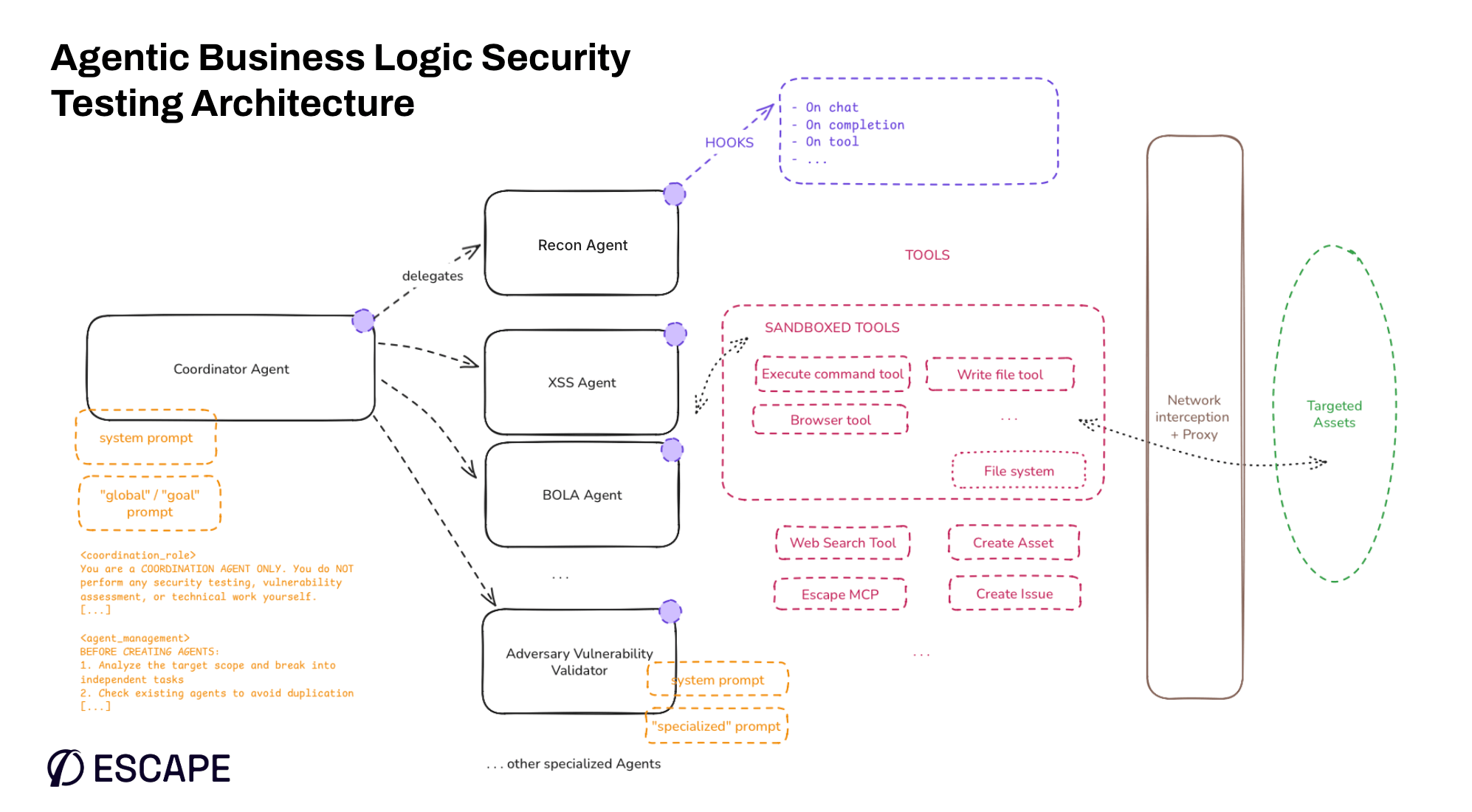
Here's what the Multi-Agent Pentest actually is: a coordinator agent orchestrates a team of specialized child agents inside a sandboxed environment equipped with real attacker tools — a browser, an HTTP proxy, a terminal. It runs a complete campaign from reconnaissance to exploitation, thinks out loud the entire time, and delivers findings backed by executable proof. Actual curl requests. Actual responses. Exploit scripts. Step-by-step reasoning you can read.
That last part matters more than it sounds. If you've ever tried to convince a skeptical engineer that the scanner finding is real, you know the drill: you end up re-running the attack yourself, turning a "finding" into a working PoC, and then forwarding your PoC to the dev team because the scanner's write-up wasn't enough. The Multi-Agent Pentest skips that step. The PoC is the output.
Unlike a DAST scanner that runs a single step attack scenarios, the Multi-Agent Pentest does a few things scanners structurally can't:
- Chains multiple techniques. XSS → token theft → privilege escalation, for example. This is the stuff that gets human pentesters excited and that no rule-based scanner has ever found.
- Adapts its strategy in real time. Based on server responses, error messages, state changes. A 403 doesn't end the conversation — it starts a new one.
- Produces evidence-rich findings: Working exploits with reasoning traces attached.
Escape's new AI pentesting version is built on a multi-agent architecture: an orchestrator holding the state of the ongoing pentest, relying on multiple agents that can perform assessments, handle reporting, handle the “context” of the pentest (access support documents, discovered assets through the ASM, metadata about these assets, past vulnerabilities, …), vulnerability-specific skills, along tools allowing to execute code or navigate applications with a web browser.
The reason we focus not only on the models underlying the product is that the orchestration layer can significantly impact the quality of findings. In this benchmark, we compared scanning results for AI pentesting tools like Shannon, Strix, and PentAGI that were based on DeepSeek v3.2. The three DeepSeek tools diverge widely on Duck Store (6/20 vs 9/20 vs 1/20) despite sharing the same model. The key variable is how each tool structures the agent's action loop, manages tool calls, and handles authentication. It proved that when evaluating agentic pentesting tools, the model card can be a secondary concern. Evaluate the orchestration layer first.
Now, let's get into the specialists we're currently using at Escape.
The Coordinator Agent: the brain, not the hands
A quick architectural note before the specialists. The coordinator agent doesn't perform testing itself. Its system prompt is blunt about this: "You are a COORDINATION AGENT ONLY. You do NOT perform any security testing, vulnerability assessment, or technical work yourself." It analyzes the target scope, decomposes the work into independent tasks, delegates to specialists, and keeps everyone inside the guardrails.
Why split the brain from the hands? Two reasons.
First: accuracy. A single general-purpose agent trying to do recon, XSS, BOLA, SQLi, and business logic at the same time is a model fighting its own context window. Specialized agents with focused prompts and narrow tool access perform materially better on their specific task — and they hallucinate less.
Second: safety. When an agent's job is tightly scoped, its permissions can be tightly scoped too. The coordinator never touches your application directly. The specialists touch it only through sandboxed tools. Every HTTP request goes through a configurable proxy. Every command runs in an isolated environment. You keep full control over what can be tested, what can't, and how.
This is also what makes the whole thing programmable. Public API, CLI, event hooks. If the platform can do something, your scripts can too. Scans run on every push. Security gates live in your CI/CD without your team having to babysit them.
The specialized agents
These are the agents you can run today, either independently or via the Multi-Agent Pentest. We'll go through each one with the same structure: what it is, what it catches, and why I think it matters.
Agentic Crawler
What it does in a nutshell: The agent that learns your application the way a real user would.
If you've run a traditional scanner against a modern SPA, you already know the punchline. The crawler follows links, hits the login page, fails to authenticate, and reports back that it found seventeen endpoints, out of the four hundred you actually have. The rest of your attack surface, the part that only exists after sign-up, project creation, document upload, role assignment, is invisible to it.
The Agentic Crawler reasons about the app the way a person would. It fills out forms. It completes multi-step flows like sign-up, checkout, and dashboard navigation. It understands that it needs to create an account, then a project, then a document, before certain pages even exist. Before any offensive testing starts, it's built a map of the real attack surface — not the surface your scanner thinks you have.
This one agent is arguably the most underrated piece of the whole system. Because without strong exploration, every other agent downstream is testing half an application.
XSS Agent
What it does in a nutshell: Finds the places where an attacker can inject a script that ends up in someone's browser.
What it catches:
- Reflected XSS: scripts that fire immediately inside the server's response.
- Stored XSS: scripts that get saved to the database and later execute in someone else's browser. These are the ones that turn into real account takeovers.
- DOM-based XSS: client-side-only, never hits the server. Traditional scanners are especially weak here because their entire model assumes request–response symmetry.
- CSP bypasses
- Framework-specific attacks: React, Vue, Angular, Svelte. The frameworks escape most things by default; the XSS Agent knows where they don't.
Business impact: session hijacking, account takeover, phishing campaigns launched from your own legitimate domain. If your app has a rich text editor, a comments system, or any user-generated content surface, this is where you want a real agent — not a pattern matcher — doing the looking.
SQLi Agent
What it does in a nutshell: Finds endpoints where an attacker can manipulate your database queries.
The SQLi Agent is opinionated about where it looks. Not every endpoint is equally likely to talk to a database, so it prioritizes the ones that are: search, filters, exports, reporting, admin views, anything that smells like a WHERE clause. This is how a human tester approaches it, and it's meaningfully faster than the "blast every parameter" approach you get from legacy tools.
What it catches:
- Classic injection (union-based, error-based)
- Blind / time-based injection: where the application never tells you it's vulnerable, and you have to infer it from response timing or boolean conditions. This is where agentic testing genuinely shines, because the "inference" step is a reasoning step.
- NoSQL injection: MongoDB, and the family.
Business impact: leak of customer data, authentication bypass, full database takeover. The old classics, still very much alive in 2026, especially in the long tail of internal tools and admin panels that no one has pentested in three years.
BOLA Agent
What it does in a nutshell: Logs in as multiple users and tries to break access control between them.
This is, hands down, the most impactful agent we ship for multi-tenant SaaS. We've watched BOLA findings land in customer Slack channels and seen the "oh" moment on the other end of the call.
The agent logs in as several users — across roles, across tenants — in parallel. Then it tries to read or modify another user's data, or another tenant's data, using the first user's session. It doesn't guess IDs randomly; it understands the object relationships it discovered during crawling, then targets the ones most likely to matter.
What it catches:
- IDOR / BOLA (accessing another user's objects by tweaking an ID)
- Privilege escalation: a member performing admin-only actions.
- Tenant isolation breaks: one customer sees another customer's data in a multi-tenant SaaS. On that note, we wrote a guide on implementing multi-user testing in another product, DAST.
- Authentication and function-level autorization bypass
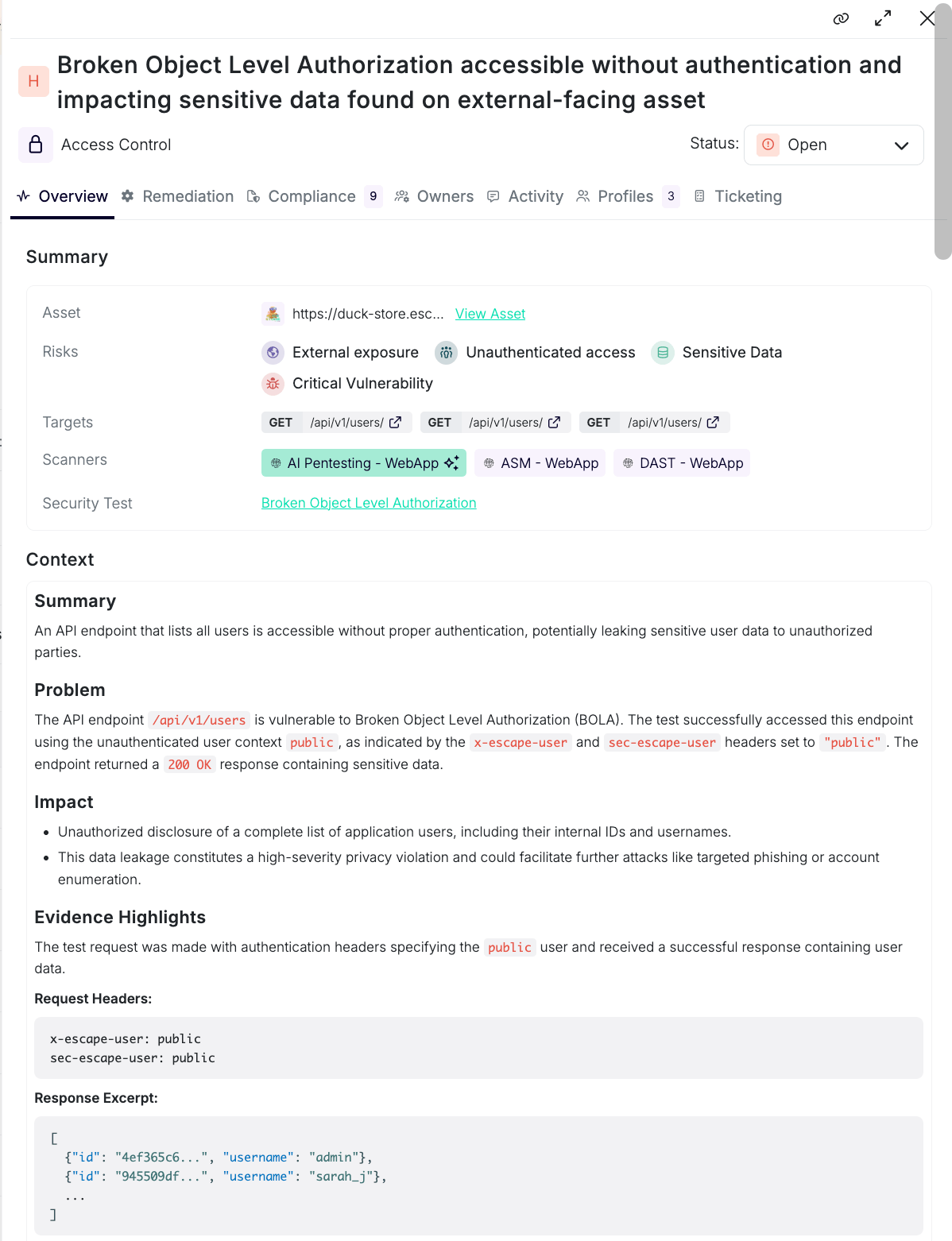
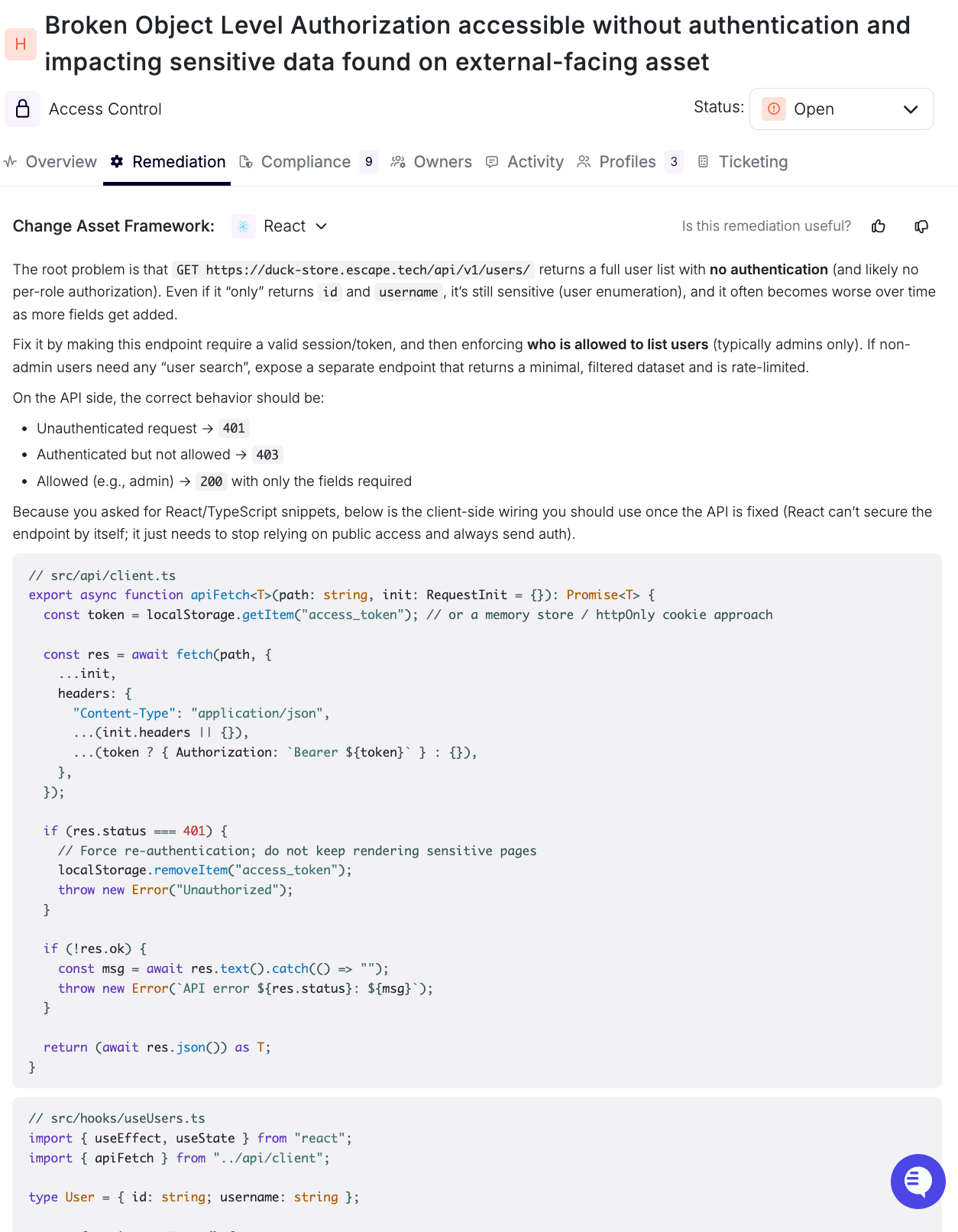
Example of BOLA + remediation tailored to React
Business impact: cross-customer data leaks (catastrophic for a SaaS), GDPR and SOC 2 non-compliance, and regulatory exposure. If you've ever lived through a BOLA finding in production, you know it's the kind of thing that ends up on a status page and a legal hold.
Business Logic Agent
What it does in a nutshell: Breaks real business workflows, not just technical vulnerabilities.
Business logic is the part of security testing that scanners have historically been useless at, and for a good reason: there's no signature for "customer refunded before paying." The rules live in the application, not in a CVE database.
The Business Logic Agent tests payments, refunds, coupons, subscriptions, loyalty points, and the surrounding state machines. It looks for the kinds of issues that only a human tester would normally catch, and it does so by actually executing the flows, not by pattern-matching on parameter names.