Microsoft Discovery: Advancing agentic R&D at scale
calendar_today
April 22, 2026
person
Aseem Datar
domainazure
Over the past year, we’ve made significant progress with Microsoft Discovery by working closely with research and development (R&D) organizations. Today, we’re sharing how those efforts are translating into real momentum for customers and partners, while also expanding preview access to Microsoft Discovery. This next phase reflects what we’ve learned as we continue to broaden access to enterprise-grade, agentic AI capabilities for R&D. The Microsoft Discovery platform continues to evolve with new capabilities, expanded partner interoperability, and a growing set of results with real-world scientific outcomes and engineering transformation. We believe what comes next can meaningfully change how R&D teams operate and empower them to achieve more.
The era of agentic AI for research and development
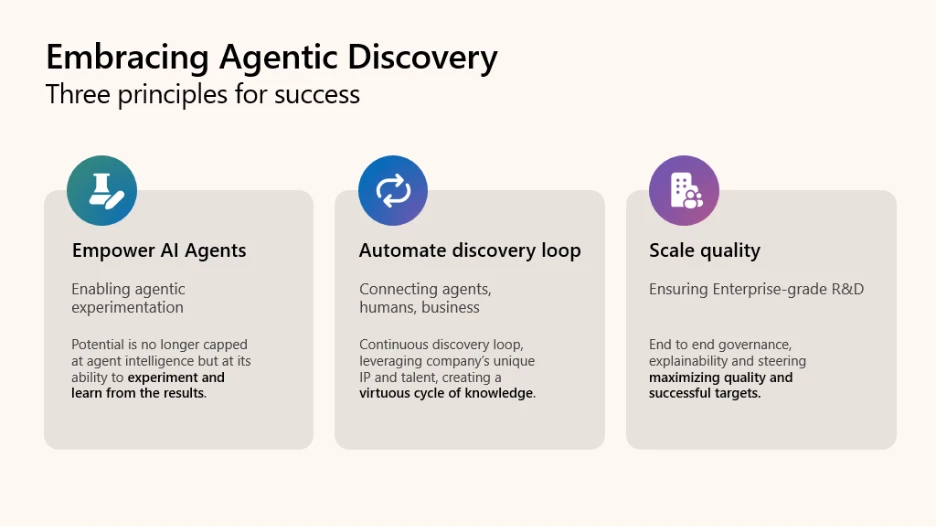
Agentic AI opens a new chapter for R&D where autonomous agent teams, guided by human expertise, perform the core research and engineering tasks in a redefined agentic loop. Specialized agents can reason on top of vast amounts of organizational and public-domain knowledge, create hypotheses on an expanded search space, test and validate those hypotheses at scale, analyze the results, and feed conclusions into iterative loops. Empowering science and engineering experts with agentic AI has the potential to reshape the future of science and engineering, enabling organizations to lead boldly in the new Frontier R&D era.
This fundamental shift requires a deep transformation that encompasses both technological and organizational challenges. Scientific discovery has always been defined by ambition and the relentless pursuit of what comes next—a more sustainable material, a cleaner source of energy, a more effective treatment. But for many R&D teams the hardest work can begin after an idea shows promise. Turning concepts into outcomes requires repeated development cycles that involve reformulating candidates as new datasets emerge, re-engineering existing materials to meet evolving regulatory and performance requirements, or adjusting designs when performance, yield, or manufacturability fall short. As R&D grows more complex, tooling must evolve to help close the distance between what researchers and engineers want to pursue and what they can practically deliver.
Earlier generations of AI offered incremental relief through faster search and better retrieval, but lacked the deeper reasoning that genuinely complex, multi-disciplinary science demands. Tradeoffs across cost, performance, yield, compliance, and timelines must be revisited repeatedly as development progresses. But the convergence of large-scale reasoning models, agentic AI architectures, and high-performance cloud infrastructure has created a genuine opportunity to rethink how R&D work gets done—not only to improve existing processes at the margins, but to help teams iterate faster and move from hypothesis to candidate development to outcome with greater confidence.